




With the arrival of summer, sun protection becomes a common concern for millions of people. However, while skin care is a widespread routine, eye health remains largely unknown to many users, even though ultraviolet radiation can also affect different structures of the eye.
Just as skin can suffer a sunburn after excessive sun exposure, the cornea can also be affected by ultraviolet radiation. This injury, known as photokeratitis, causes symptoms such as eye pain, tearing, foreign body sensation, or photophobia, and can occur after intense exposure in environments such as high mountains, snow, or certain water activities. “Protection against ultraviolet radiation is not an aesthetic matter or solely about visual comfort. It should be understood as a long-term preventive measure for eye health,” explains Cortés Pozo, Product Manager at Grupo Prats and an optician-optometrist.
Accumulated Sun Exposure Also Matters
The relationship between ultraviolet radiation and certain ocular alterations is widely documented in scientific literature. A review of 22 epidemiological studies published in the journal Ophthalmic Epidemiology concluded that there is consistent evidence of an association between ocular exposure to UV-B radiation and the development of cortical cataracts, one of the most frequent forms of this pathology.
The World Health Organization itself estimates that up to 10% of cataract blindness cases worldwide could be related to overexposure to ultraviolet radiation, making eye protection a relevant preventive measure from a public health perspective.
One of the most sensitive structures is the crystalline lens, responsible for absorbing a large part of the ultraviolet radiation that penetrates the eye. Scientific evidence has linked accumulated sun exposure to photochemical alterations that, over the years, can promote the progressive opacification of this structure.
Likewise, various scientific studies have described the relationship between ultraviolet radiation and certain degenerative alterations of the conjunctiva, such as pterygium or pinguecula, especially common in people who perform a good part of their work or recreational activities outdoors.
Protection is especially important during childhood. Children’s crystalline lenses are more transparent and filter less ultraviolet radiation than adults’, so a greater proportion of radiation reaches the internal structures of the eye. Furthermore, the accumulated exposure that will determine future visual health begins precisely in these early stages of life.
UV Protection Is Not Exclusive to Sunglasses
One of the most common mistakes is to think that protection against ultraviolet radiation depends exclusively on wearing sunglasses. “Many people are unaware that quality clear ophthalmic lenses can also incorporate protection against ultraviolet radiation. The fact that a lens is clear does not mean it lets UV radiation pass through,” notes Cortés Pozo.
The explanation is simple. Ultraviolet radiation is part of the non-visible spectrum to the human eye. Therefore, a lens can completely block this radiation without altering visual perception or modifying its transparency.
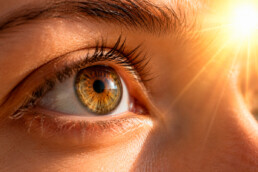
In fact, current ophthalmic lenses commonly incorporate UV protection through the manufacturing materials themselves and the treatments applied to the lens surface. Consequently, a clear lens can contribute to daily eye protection without needing to have a solar tint.
Optics: An Ally for Visual Prevention
The choice of appropriate lenses should not be based solely on aesthetic criteria. Protection against ultraviolet radiation, the optical quality of the lens, and its adaptation to the intended use are fundamental factors to ensure a satisfactory visual experience. “Optical stores are specialized health establishments where users can receive professional advice on which type of lens best suits their visual needs, their prescription, and their lifestyle,” explains Cortés Pozo.
The specialist reminds us that not all lenses offer the same optical performance. In addition to protection against ultraviolet radiation, manufacturing quality and lens design directly influence aspects such as sharpness, reduction of possible distortions, and visual comfort during daily use. Therefore, she recommends always going to specialized establishments where users can receive professional advice and learn about the specific characteristics of the lenses they use.
Technology to Protect and Enjoy Summer
Beyond protection against ultraviolet radiation, current optical solutions allow lenses to be adapted to different lifestyles and activities.
In situations such as driving, sports, or water activities, polarized lenses help reduce glare and increase contrast, promoting clearer and more comfortable vision. PRATS has recently expanded this range with the incorporation of a new blue polarized option, combining visual performance and aesthetic trends.
Meanwhile, photochromic lenses automatically adapt to changes in light, darkening outdoors and progressively regaining their transparency indoors. This technology allows combining UV protection and visual comfort in a single lens. Additionally, the company has incorporated new blue and green shades into its photochromic offering.
Personalization is another trend transforming the optical market. In this regard, PRATS has developed Sun Demo Tool, a digital tool that allows users to visualize different solar lens options on their own frames, including solid colors, gradients, mirrored, and polarized. “Today we have solutions that combine protection, optical quality, visual comfort, and design. The important thing is to understand that protecting your eyes from the sun is a preventive measure that can accompany us throughout life,” concludes Cortés Pozo.

Related News
Here is a brief selection of the most-read content from our Press Room.

Irene Cabrera, Miss RNB Spain Global 2026, the face of PRATS Sun Select
The Spanish multinational is strengthening its commitment to personalization…

PRATS launches its new 2026 General Catalog to respond to new visual habits
The company incorporates new solutions such as the PRATS BIO, Work Use, and…

Grupo Prats Strengthens Its Leadership at ExpoÓptica 2026 with PRATS Bio, PRATS Gamer Lenses, and New Apps for Opticians
The company is committed to sustainability, solutions for the digital…
PRATS launches The Airon Game to promote QUARZ AironUV+, its most transparent anti-reflective coating
The new promotion rewards professionals' confidence in QUARZ AironUV+, PRATS'…

The invisible high technology behind a pair of glasses
Anti-reflective coatings and Spanish optical design that transform a lens into…
Grupo Prats introduces PRATS Unique ID, a new digital, traceable identity for every lens
Grupo Prats, a benchmark in optical innovation with more than 100 years of…